


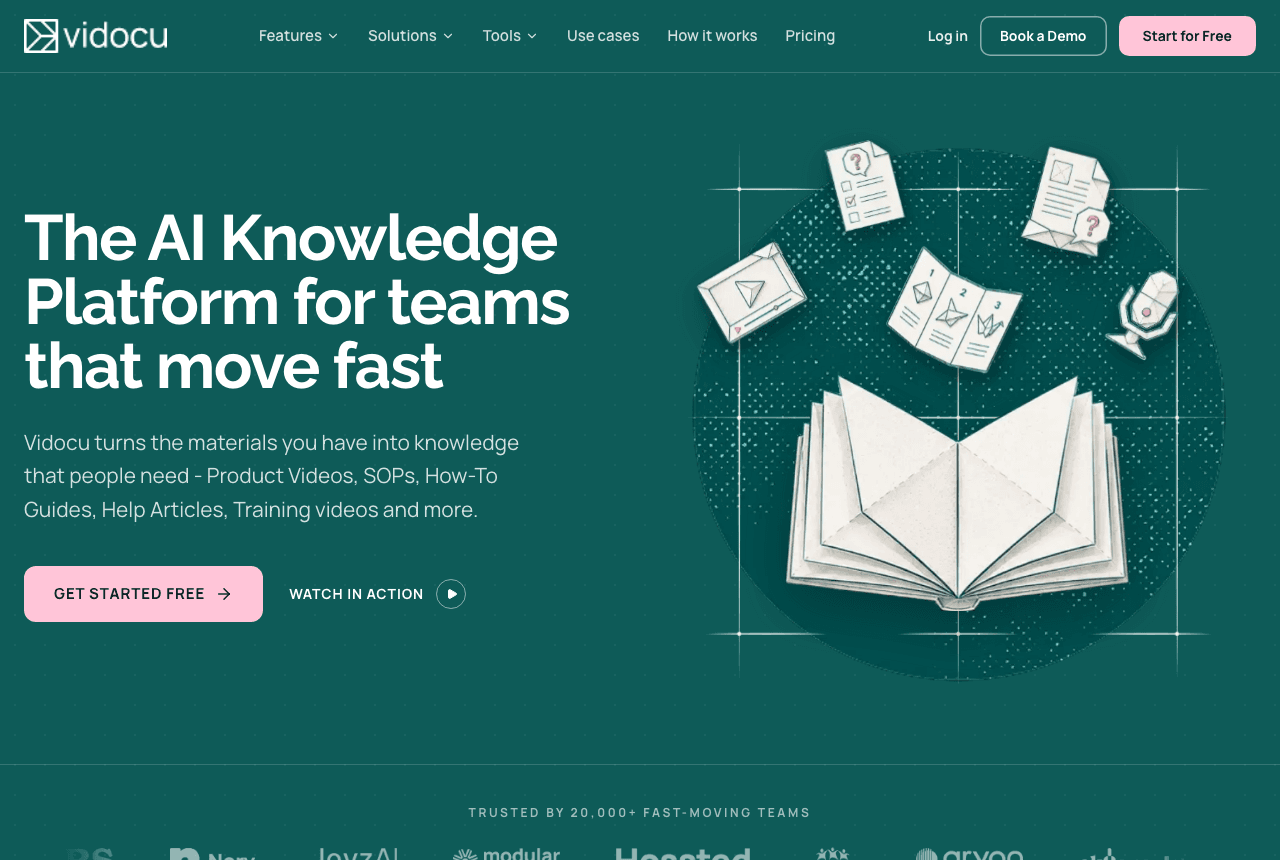
Vidocu looks different this week. New teal, warm paper surfaces, a fold mark instead of a gradient. New look, same Vidocu: same account, same links, same product you were using yesterday.
The new look is also the last item on the list, not the first. What actually changed is the product. Vidocu started as an internal workaround for one small team, launched as a tool that did exactly one job, and has since grown into a platform that teams use to create and maintain the knowledge their whole company runs on. The brand had been describing the first version of that story for a long time.
Here is the full arc, and what it means for what Vidocu does now.
Chapter 1: We built it for ourselves
Vidocu was not a startup idea. It was a workaround.
We build Common Ninja, a platform that lets businesses add functionality to their websites without code. Hundreds of widgets, dozens of integrations, several website builders, each with its own quirks. It is powerful, and that makes it complex to explain. (The longer backstory is here.)
We are a small team. No documentation department, no video team. So we did what small teams do: we recorded our screens. A two-minute walkthrough explains a flow better than three paragraphs ever will.
Recording was never the bottleneck. Everything after the recording was.
Every video needed subtitles so it worked without sound. Most needed a clean voiceover. Many needed translation for users who do not read English. And every one of them still needed a written help article, with screenshots, annotations, and formatting, so the information would be searchable inside our help center. Then the UI changed and all of it went stale at once.
A "quick video" turned into hours of post-production. So we stopped shopping for tools and built one, around a single question: what if one video could generate everything around it automatically?
That internal experiment became Vidocu. We wrote about that period in why we built Vidocu.
Chapter 2: We launched doing exactly one thing
When we took Vidocu out of the building, it did one job: turn a video into documentation.
Upload a screen recording. Get back a structured step-by-step article with the right screenshots pulled from the footage, plus subtitles and a voiceover generated from the same source. One upload, aligned outputs, no stitching between four tools.
That was the entire product, and it was narrow on purpose. A tool that does one thing well is easy to explain, easy to try, and easy to judge. It also answers the only question that mattered at that stage: is this our problem, or everyone's?
It was everyone's. Support leads, product marketers, technical writers, ops managers, solo founders. Same complaint, phrased slightly differently every time: recording is fast, everything after it is slow.
See what one upload produces
Video, subtitles, voiceover, translation, and a step-by-step article, generated from the same recording.
Try it freeChapter 3: Our customers designed the next three years
Almost everything Vidocu can do today exists because someone asked for it. Not in a roadmap survey. In a support thread, usually with a real deadline attached.
Looking back, the requests fall into six groups, and each one pushed the product further from "tool."
Control. "The article is right, but this screenshot is wrong." AI drafts are only useful if you can fix them. So we built editors: a video editor, a subtitle editor, an article editor. Generate the draft in a minute, then keep full control of the result.
Reach. "Our users are in Germany, Japan, and Brazil." Video translation grew to more than 65 languages, covering translated subtitles, translated voiceover, and translated articles from one source video. No re-recording, no separate localization vendor.
Craft. "This still looks like a raw screen recording." So came zoom and pan, callouts and annotations, background music, slides, avatars, and eventually Studio, a multi-track editor for people who want real post-production instead of a preset.
A destination. "The articles are great, but we have nowhere to put them." So we built Knowledge Center, a hosted AI help center that runs on your own domain with semantic search across your content. That one got its own launch post.
Proof. "Our people need to show they read the SOP." Training modules followed: quizzes generated from a video or an article, with tracking and sign-off, for teams that answer to auditors rather than to a content calendar.
Capture. "We do not have anyone free to record the walkthrough." So we built the AI Recorder. Describe a workflow in plain language and an agent opens a real browser, performs the steps itself, and records itself doing it. Because the agent performs each click, it knows exactly which element was clicked, so zooms and spotlights land on the right thing instead of being guessed from cursor movement after the fact.
And underneath all of it, two things that quietly changed who could use Vidocu: a developer API plus an MCP server, so other products and AI agents can run Vidocu jobs directly, and more than 40 free tools that each do one small job, from trimming to subtitle burning to turning a presentation into a video.
None of that came off a five-year plan. It is accumulated feedback from teams doing the work, including enterprise customers now running regulated documentation, multilingual onboarding, and internal training on Vidocu. Roughly 20,000 teams use it today.
Chapter 4: What changes when a tool becomes a platform
Three things shifted along the way, and they are worth naming, because they explain why "video tool" stopped being an accurate label.
The input stopped being just video. Teams arrive with a recording, a PDF, a slide deck, a transcript, an existing help article, or nothing at all and a description of a workflow. Video is still the most common starting point, but it is no longer the only door in.
The output stopped being one file. A single source now fans out into a polished video, a step-by-step SOP, a help article, a summary, a short vertical cut, a quiz, a presentation, and a knowledge base entry. Same source, many channels, all consistent with each other.
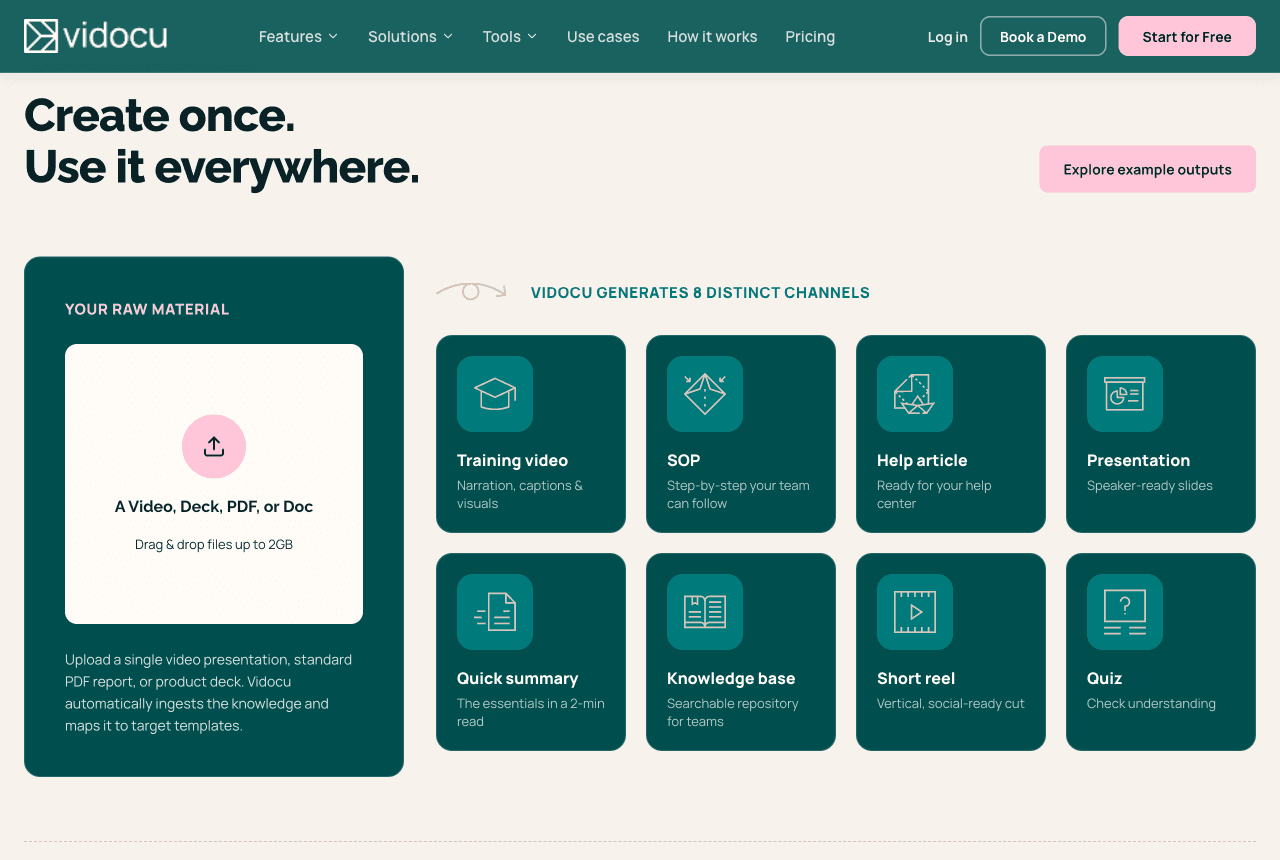
The job stopped ending at export. This is the real difference. A tool converts a file and hands it back. A platform owns the lifecycle: generate it, edit it, translate it, publish it, keep it current when the product changes, and prove someone actually read it. That is the part teams were stitching together manually, and it is the part that decides whether documentation stays useful six months later.
Put simply: Vidocu stopped being the thing you open after recording a video, and became the place your company's knowledge lives.
That is why the description is now the AI knowledge platform for teams that move fast. It covers customer support teams cutting ticket volume, training teams onboarding staff in six languages, and technical writing teams maintaining docs that stop going stale the week after every release.
One upload. Everything generated.
Videos, subtitles, voiceover, translations, articles, SOPs, and quizzes from a single source.
Start for freeChapter 5: The brand was the last thing to catch up
Which brings us back to the new look.
Purple with a gradient is what every AI tool looked like in 2023. It said "clever single-purpose utility, probably a wrapper, use it once and move on." That was a fair description of Vidocu at launch. It is not a fair description of a system that companies now trust with their training material, their SOPs, and their public help center.
So the identity was rebuilt around one idea: the fold. Paper being folded into something useful. Knowledge that already exists inside your company, shaped into a form other people can actually use.
| Element | Before | Now |
|---|---|---|
| Primary color | Purple #5B36AD | Core teal #007A7A |
| Surfaces | White cards, purple gradients | Warm page #F7F2EC, paper cards #FFFAF5 |
| Typography | Satoshi and Clash Display | Raleway for headlines, Manrope for everything else |
| Shapes | Pill buttons, heavy rounding | 8px radii, pills only for chips and tags |
| Texture | Gradient washes | Flat paper surfaces, dotted grids, fold lines |
| Mark | Wordmark on a gradient | Fold mark |
Three of those choices carry most of the weight:
Warm paper instead of white. Nothing in the app is brighter than the paper surface. If you spend an hour editing a subtitle track or an article, the interface should not glare at you. Pure white is now reserved for things that are not surfaces at all, like a toggle knob or a play button over video.
No loud gradients. Editors are already full of color: timelines, waveforms, subtitle tracks, thumbnails. The brand's job is to stay out of the way of your content, not to compete with it.
Typography that works at both ends. Raleway carries the headlines, Manrope carries every piece of UI and body text. Both stay readable at 12px inside a dense timeline and at 64px on a landing page.
New look. Same Vidocu.
Everything you use stays exactly where it was:
- Your account, projects, and videos. Nothing moved. Same login, same workspace, same content.
- URLs and links. Every page, help article, and shared video link still resolves.
- The API and MCP server. No breaking changes, nothing to migrate.
- Pricing. Untouched by the rebrand.
- The name. Vidocu stays Vidocu.
Two loose ends, in the interest of being straight about it: the video assets rendered into exports, meaning the optional Vidocu intro and outro scenes and the default watermark, are being updated to the new brand in a coming release, and older blog cover images still carry the old palette. Both are cosmetic and both will catch up.
What comes next
The rebrand closes the gap between what Vidocu is and what it looks like. It does not close the roadmap. If anything, it clears the way for a much bigger one.
So here is the goal, stated plainly: one platform for creating any kind of knowledge, and getting it to the people who need it.
Every company runs on knowledge that sits in the wrong place. In a senior engineer's head. In a recording nobody watched twice. In a deck from a launch two quarters ago. In one support agent's saved replies. That knowledge has three audiences, and most companies serve them today with three disconnected stacks:
- Teams need internal documentation, runbooks, and process docs that reflect how the work is actually done this month, not last year.
- Employees need onboarding, training, and certification, with proof that people completed it.
- Customers need help centers, tutorials, and product education in their own language, findable at the exact moment they are stuck.
Same source knowledge. Three audiences. One platform should carry all of it, from capture to creation to delivery, and keep every version current when the product underneath it changes.
That is what we are building toward. In practice: more agentic capture, so less knowledge has to be recorded by hand. More languages, so geography stops deciding who gets a good explanation. Deeper knowledge management, so content maintains itself instead of quietly decaying. And better delivery, so what your team knows reaches the person who needs it, in the format they will actually use.
If the last time you looked at Vidocu it was a video-to-docs tool, it is worth another ten minutes. See how it works, or try it free.
FAQ
What is an AI knowledge platform?
A system that turns the material a company already has, such as recordings, documents, decks, and transcripts, into content people can use, and then keeps that content edited, translated, published, and current. The difference from a tool is the lifecycle: a tool converts a file and hands it back, a platform manages what happens to that knowledge afterwards.
Is Vidocu still a video-to-documentation tool?
Yes, and it is still the most popular workflow. It is now one capability inside a larger platform that also covers AI recording, multi-track editing, hosted knowledge bases, translation into 65+ languages, quizzes, and an API.
Did Vidocu change its name?
No. Only the visual identity and the positioning changed. The product is still called Vidocu, the domain is still vidocu.ai, and your account is unchanged.
Do I need to do anything because of the rebrand?
No. Logins, projects, videos, articles, shared links, and API integrations all keep working exactly as before. Nothing was migrated and nothing was deprecated.
Why did Vidocu change from purple to teal?
The purple gradient identity was designed for a narrow single-purpose tool. Vidocu now covers recording, editing, translation, documentation, publishing, and training, and enterprise teams use it for regulated content. The teal and warm-paper identity is calmer, more durable, and matches what the product actually became.
Will my exported videos look different?
Your content is untouched. The optional Vidocu-branded intro and outro scenes and the default watermark are being updated to the new brand in a coming release. If you use your own logo and watermark, nothing changes at all.
Vidocu turns the material your team already has into knowledge people can use. Try Vidocu for free.

Written by
Daniel SternlichtDaniel Sternlicht is a tech entrepreneur and product builder focused on creating scalable web products. He is the Founder & CEO of Common Ninja, home to Widgets+, Embeddable, Brackets, and Vidocu - products that help businesses engage users, collect data, and build interactive web experiences across platforms.